AI AUGMENTED ARCHITECTURE

Architects decide. AI handles the rest.

AI Augmented Architecture is not about replacing architects. It is about removing the mechanical overhead that gets between architects and the decisions that require their expertise.

THE CURRENT STATE

What architects actually spend their time on

Before an architect makes a single decision on a new brief, a significant portion of the morning is already gone. Not on judgment. On mechanics.

Element lookup

Finding the right existing elements in the repository, by name, package, and type. Deciding what gets reused, what gets created fresh. Cross-referencing the MDG to confirm the right stereotype before the first connector is drawn.

Connector verification

Confirming connector types against the Quick Linker convention. Checking for mismatched stereotypes. Making sure tagged values on relationship ends are correct before the model goes anywhere near a review.

Pre-review validation

Running governance checks by hand before the model reaches the review board. Finding the same classes of error on every brief. Spending Thursday afternoon resolving issues that were avoidable on Monday.

Stakeholder briefing preparation

Translating model labels from architect language to business language. Pulling ownership, criticality, and dependency data from tagged values by hand. Rebuilding slide content that already exists in the repository.

WHAT CHANGES

When AI handles the mechanics, architects do architecture

The architect provides the intent and the instructions. The AI handles the execution. The judgment stays with the architect. The mechanical heavy lifting moves to the AI.

Architecture Modeling

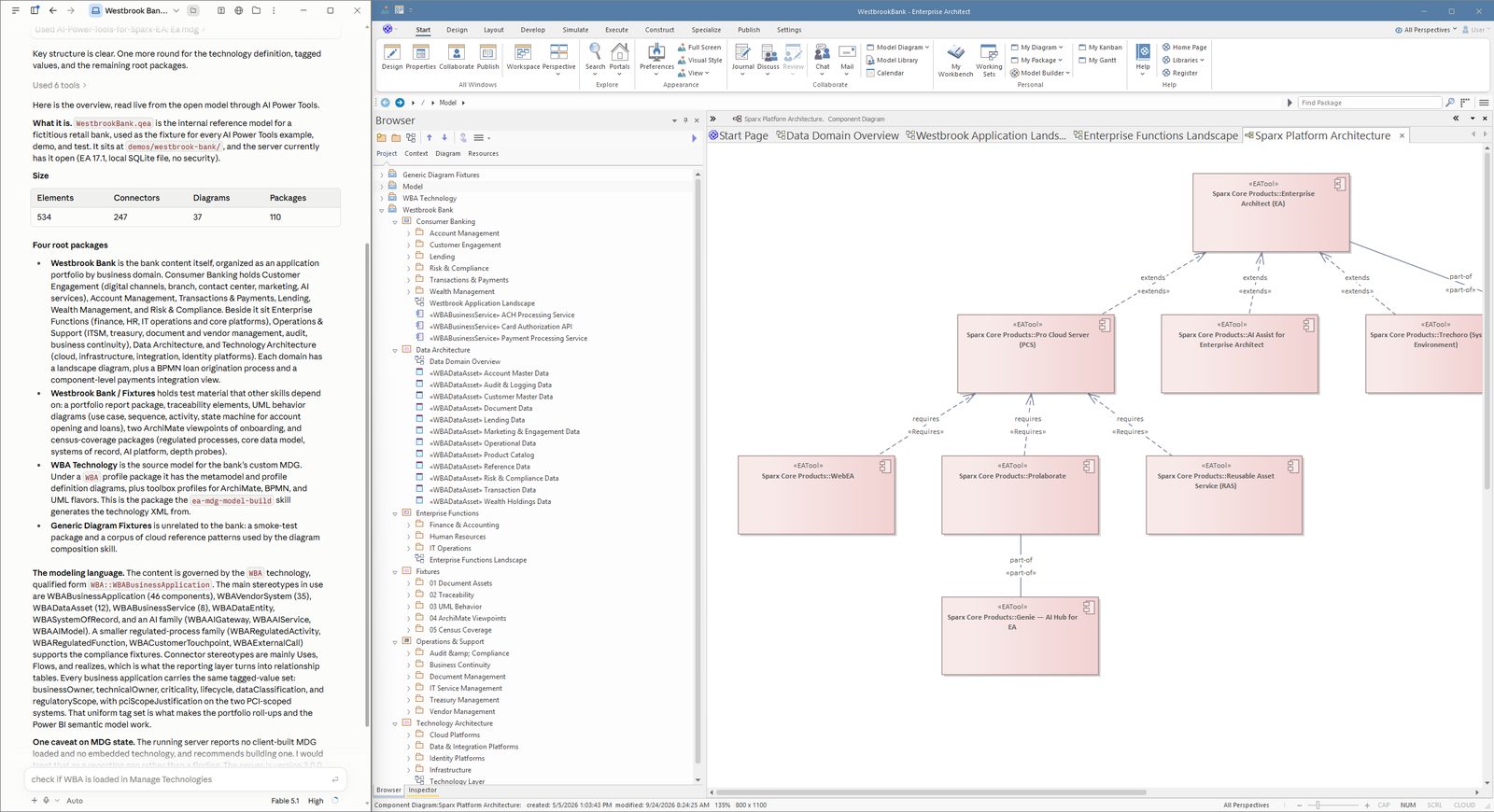
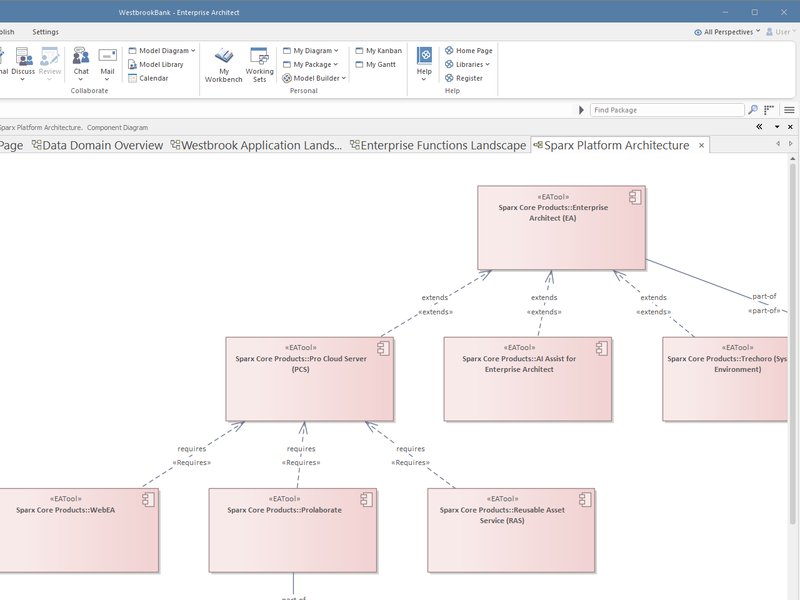
Paste a project brief into the AI interface alongside your running Sparx EA session. AI Power Tools for EA queries your repository, finds existing elements by name, creates new ones with the correct stereotypes, types the connectors to your MDG Quick Linker convention, and returns a working diagram. Under five minutes for a starting point an architect can evaluate and refine.

Architecture Analysis

Ask the AI to analyze an area of your repository: technology risks, dependency chains, component reuse opportunities. It queries the live model and returns structured findings with the specific elements and relationships cited. Not a summary of what you told it. An analysis of what is actually in the model.

Architecture Governance

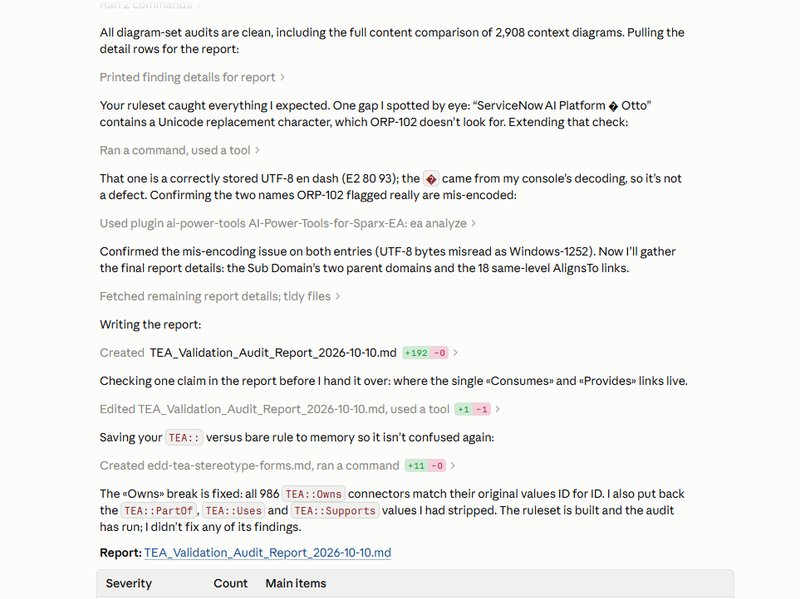
Run governance validation before the model goes to review. Findings surface with the specific rule cited, a suggested fix, and a clear distinction between what can be corrected mechanically and what requires a senior reviewer. Mechanical errors get resolved before review. The review conversation is about the finding that actually requires judgment.

Stakeholder Engagement

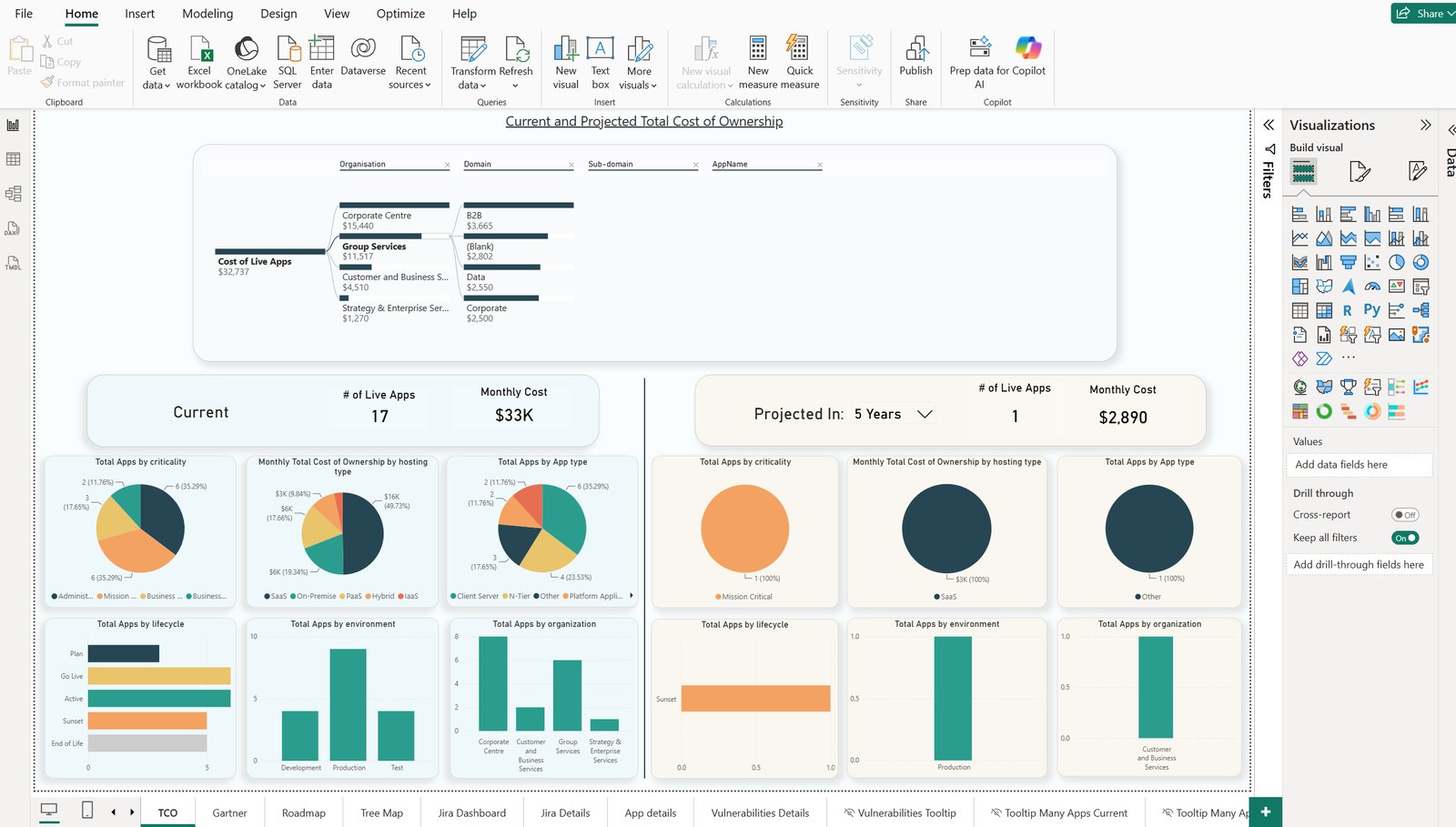
Generate a plain-language briefing on an initiative directly from the model. The AI applies MDG-defined business aliases, pulls ownership and criticality from tagged values, and produces a dependency summary from the actual repository data. Forty minutes instead of four hours. And it is accurate because it comes from the model.

THE PRODUCT

AI Power Tools for EA

AI Power Tools for EA is the product that makes this work. It is an EA MCP Server, a connector that runs between your AI interface and your live Sparx EA session.

Your architects already use Sparx EA. The AI-augmented architecture practice your organization needs does not require migrating away from it. Nothing gets replaced. Your repository stays where it is. The AI connects to it directly.

Works alongside Claude Cowork, Claude Code, GitHub Copilot for VS Code, and Microsoft 365 Copilot.

See AI Power Tools for EA →

What it does

Connects directly to your running Sparx EA session
Queries your repository, not AI training data
Applies your MDG, your stereotypes, your Quick Linker convention
Validates against your governance rules at creation time, not review time
Generates stakeholder briefings from your tagged values and model data
Runs inside the AI interfaces your architects already use

HOW WE HELP

Three ways Sparx Services gets you to AI Augmented Architecture

Plan
Understand your starting point
  • Identify the AI Augmented Architecture use cases relevant to your practice
  • Assess your Sparx EA deployment readiness for AI
  • Review the technical operating environment
  • Assess training needs for your architecture team
  • Build an achievable plan aligned to your goals
Learn about Plan →
Train
Build the habit across your team
  • Architects trained on AI Augmented Architecture workflows
  • Mentoring engagement for individual architects
  • Sparx Office Hours for ongoing team-based mentoring
Learn about Train →

WHERE IT APPLIES

AI Augmented Architecture scenarios

AI Augmented Architecture applies across the full scope of EA practice. Each scenario maps to a specific type of work architects already do, with AI handling the mechanical overhead.

Design solution architectures against your MDG, with AI-assisted first drafts from a project brief. Elements are found or created with correct stereotypes. Connectors are typed to your Quick Linker convention. Governance is validated before the model reaches review.

See the Solution Architecture scenario →

See AI Power Tools for EA running in a real Sparx EA environment.

Watch the demo, or schedule a call and we will walk through it against yours.