
AI-Augmented Governance in Sparx EA
Define your modeling standards inside Sparx Systems Enterprise Architect, turn them into rules that run, and keep every model complete and consistent, so the model is something AI and reporting can trust.
What the work is
Governance is making sure models are complete and conform to the organization’s standards. In most organizations it is manual: architects are trained to model a certain way, and an architecture review board reads model contents and gives feedback.
Sparx Systems Enterprise Architect has no preset metamodel. Architects can use any modeling language and model almost anything, which is its strength and its weakness. The answer Sparx provides is the MDG Technology: a custom modeling language for your organization that defines the metamodel, the stereotypes, the required and optional connectors, the shape scripts, the diagram templates and more.
To govern a Sparx repository you need standards, and they need to be defined and managed inside the platform itself. That is what an MDG is for, and it is where regulatory compliance work and reporting both depend on the model being right.
What changes when the standard lives in the repository
Most Sparx repositories either have no MDG or are not configured to make architects follow one. Creating an MDG, teaching modelers to use it and validating conformance was complicated to build and tedious to maintain, so most teams never got there.
That has changed. With AI-Augmented Architecture governance, an architect can prompt an MDG Technology into existence, either by combining parts of existing modeling languages or by running a census on a model your architects have already built and deriving the language from it. Then they can go further: create a validation ruleset against the MDG, run audits in architecture reviews or on a cycle, and let modelers check their own work as they create it, so issues are fixed at the source.
What it gives the team: complete and consistent models. Using architecture models as a source for AI and reporting only succeeds when the models are complete and consistent, and governance is what gives you that.
What your architects can now get done
Each task shows how architects do the work today, how it changes with AI, and the skill it now asks of them. AI is only as good as the person prompting it.
Derive your modeling language from what your architects already built
Today the standard is in people’s heads and in a document, and the repository holds whatever each architect chose. The AI-augmented way is to run a census on the repository: AI reports which stereotypes, tagged values and connector patterns are actually in use, and drafts an MDG Technology from them. If you would rather start from a standard, AI composes the MDG from parts of ArchiMate, UML, BPMN, SysML or any other language you choose.
The skill is telling policy from history. A stereotype found in the repository may be the standard or an accident, and only someone who knows the organization can say which belongs in the language.
Roll the modeling language out and have the repository enforce it
Today an MDG, if there is one, is installed by hand and nothing stops an architect from modeling outside it. The AI-augmented way is to have AI build the MDG Technology from the definition, install it, test it, and configure the repository so the language and its diagram templates are what architects pick from.
The skill is deciding when to roll out, to whom, and how to roll back, and what happens to the models built before the standard existed.
Turn the standard into a validation ruleset
Today conformance is checked by eye, if at all. The AI-augmented way is to state the standard in plain terms and have AI turn it into a ruleset against the MDG, with each rule tested, so conformance can be checked by running the rules instead of reading the model.
The skill is stating the standard precisely and telling which rules reflect it and which are habit.
Run audits in architecture reviews and on a cycle
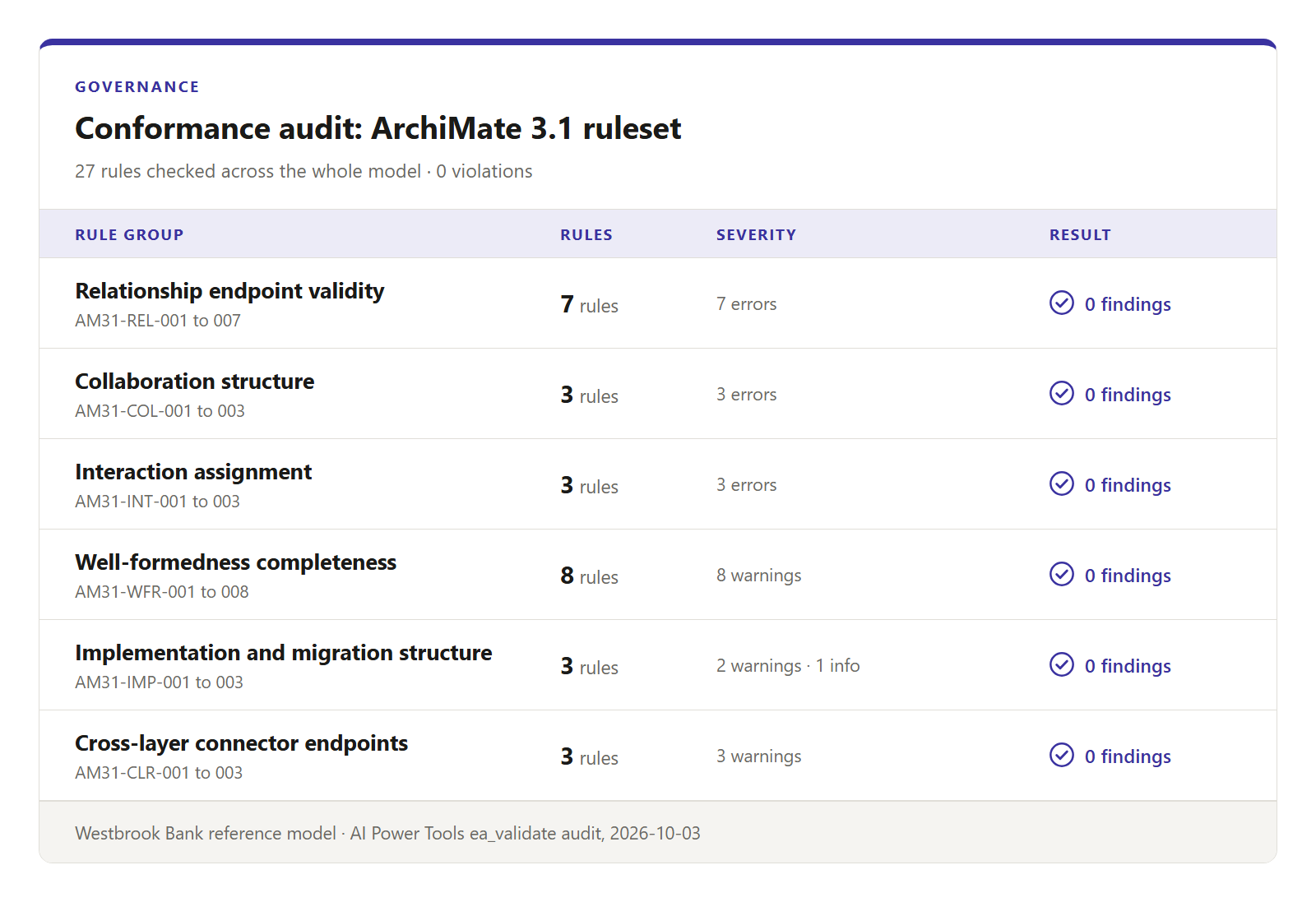
Today a review board spends its first forty minutes on missing stereotypes and unnamed owners before anyone reaches the design decision. The AI-augmented way is to run a conformance audit before the meeting, or on a schedule across the whole repository, and get findings grouped by rule.
The skill is reading the findings: deciding what each one means, which are worth fixing and which point at a standard that needs to change.
Let modelers check their own work and fix issues at the source
Today a modeler finds out about a problem weeks later, in a review or when a report looks wrong. The AI-augmented way is to run the same rules while modeling, so an architect checks a package as they build it and fixes it before anyone else sees it.
The skill is treating the check as part of the work rather than as the gate at the end.
Keep the modeling language and the rules current
Today the MDG and the checks drift apart as the standard changes, because updating both by hand is a project. The AI-augmented way is to describe what changed in the standard and have AI update the MDG and the ruleset together and test them before they roll out.
The skill is deciding when the standard has really changed and what happens to models built under the old one.
Which tools help with this job, and when
For governance, the right tool depends on where the rules need to run and who needs to see the record. AI Power Tools runs under each architect’s own EA login and has no central audit layer of its own; Kernaro AI Hub is where a team gets one.
- Claude + AI Power Tools
The widest range of guided governance work: the repository census, writing and deploying the MDG Technology, authoring and testing the ruleset, and running audits on the live repository.
- GitHub Copilot + AI Power Tools
Runs the audits and repository checks from VS Code, for architects who already work there.
- Kernaro Assist
Validates against the standards defined in the repository as architects model, inside Enterprise Architect.
- Kernaro AI Hub
Adds central control for a team: access control, SSO and an audit trail of who did what. Fixes are made in EA, or through Intelligent Flow automations where configured.
The human skills that make governance work
AI can build the language, write the rules and run the checks. What it cannot do is decide what the standard should be. These calls stay with the architect:
Which rules reflect the real standard and which are habit. A census shows what architects did. The architect says what they should do.
Whether a stereotype is policy or history. Only someone who knows the organization can tell.
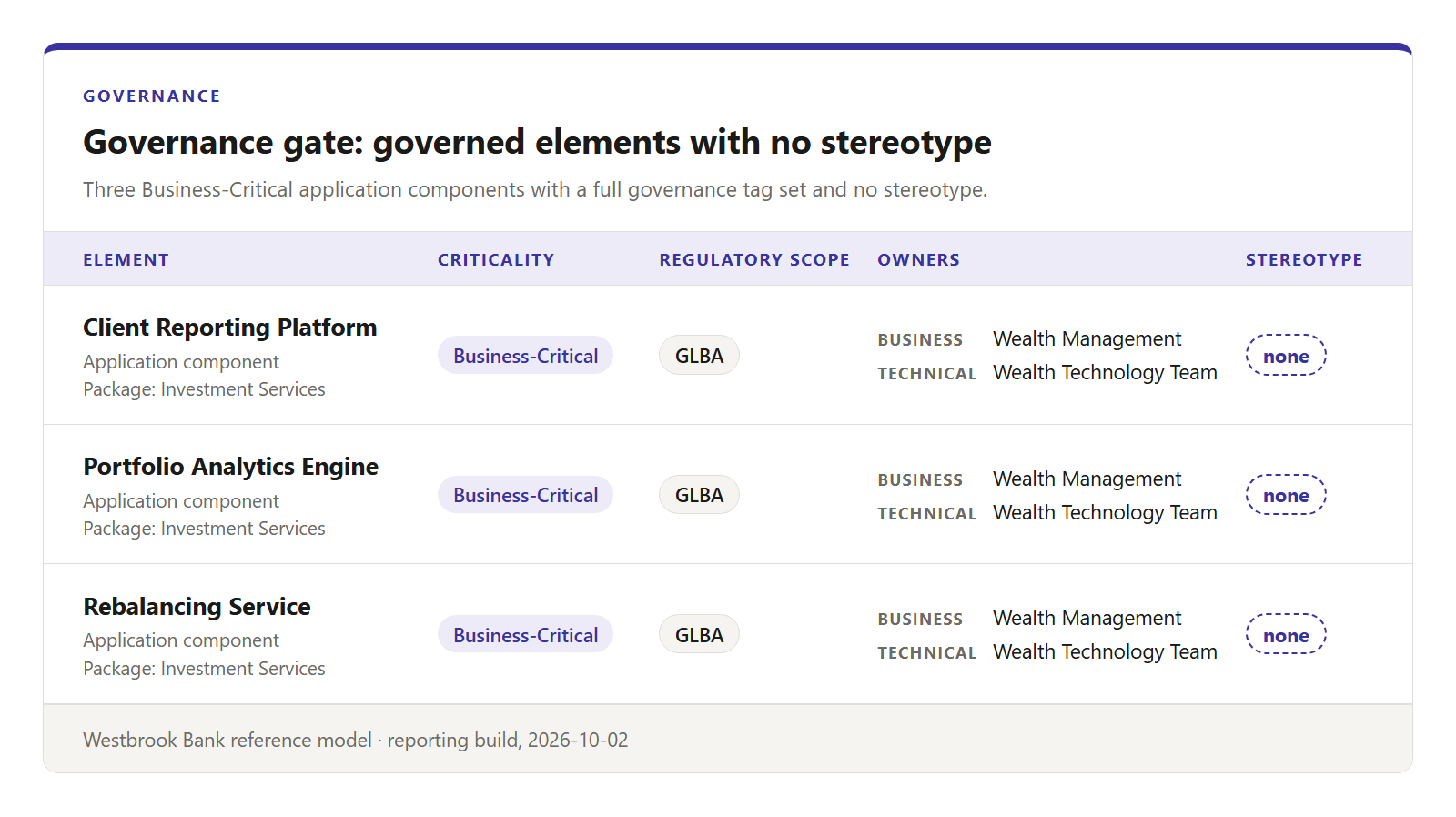
What a finding means and what to do with it. On the Westbrook Bank reference model, a fictitious model we use for teaching, the check surfaces three Business-Critical, regulation-scoped components with no stereotype. The tool reports them. The architect decides what they should be.
Automation checks completeness, people own correctness. Knowing the architecture well enough to make the call, and knowing what to ask next, is what our training and mentoring build.
How we help
Train and mentor your architects
Training and mentoring that teach your architects to define the standard as an MDG, turn it into rules and run the checks themselves. The rules your reviews already argue about become the first ruleset, and we stay with the team until the checks are part of how they model.
Foundations courses:
For ArchitectsBuild the MDG and the ruleset for you
Consulting for organizations that are capacity constrained or need results quickly. We derive or compose your modeling language, build and deploy the MDG Technology, write and test the validation ruleset, and hand them over with the repository configured to enforce them.
Build and update your architecture model for you