
We teach your architects to work this way
AI-Augmented Architecture means the architect decides what should be done and AI does the mechanics in the tool and the model. That changes the job: how much an architect gets done now depends on how well they can articulate what they want and how quickly they can review what comes back. We teach your architects to work this way, on your own repository with the AI they already have, and mentor them until it sticks.
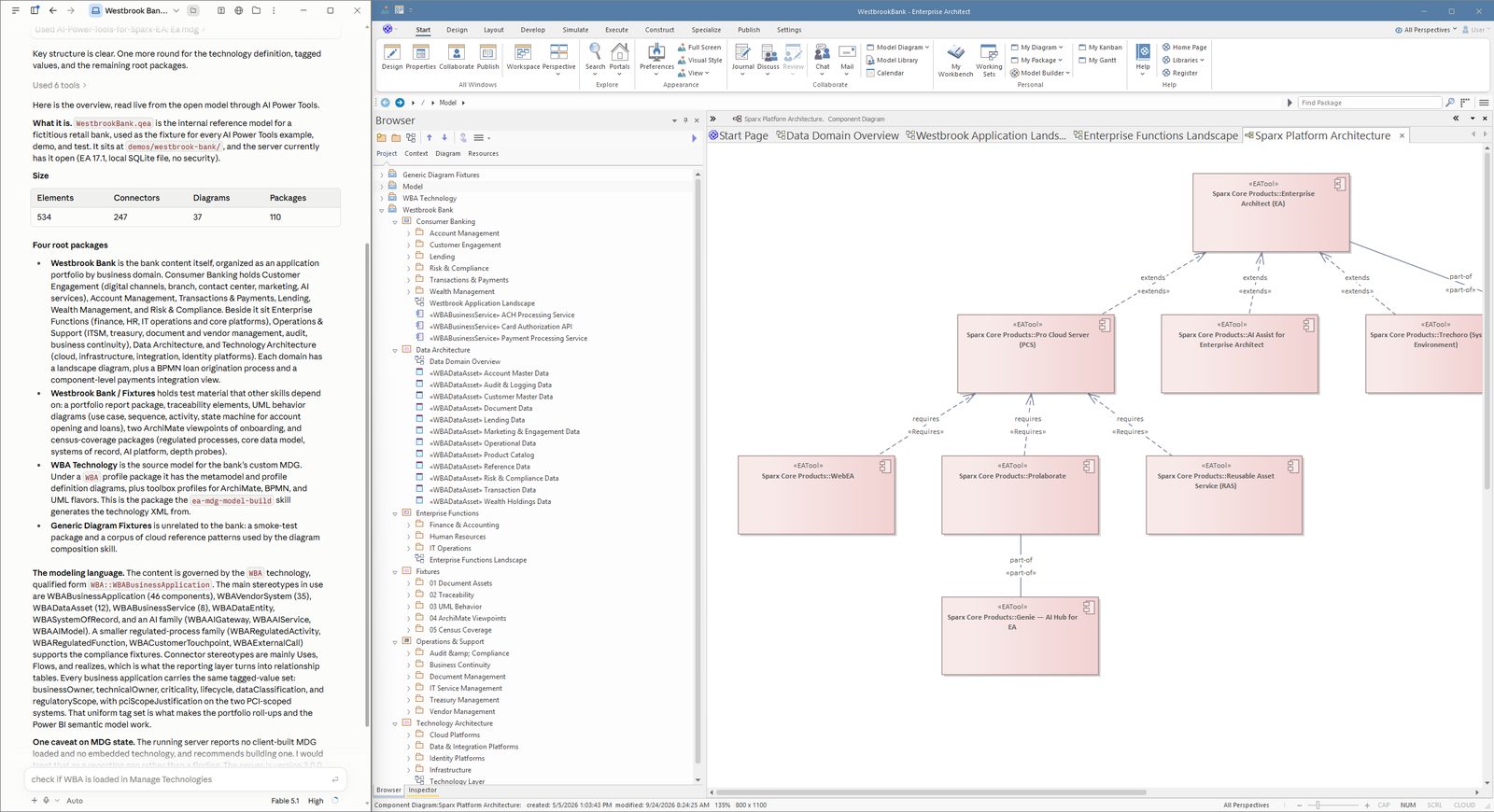
We train and mentor your architects
An architect's capacity used to be set by how fast they could operate the tool. Now it is set by how well they can articulate what they want and how quickly they can review what comes back. AI is a tool, and the person using it decides the result, so we teach the person: how to state the intent, set the standard and judge what AI produces, across modeling, analysis, governance and stakeholder work.
We teach it on your own repository, with the AI your team already has, in the context of your architects' own work, and we stay with them until the new habits stick.
We start with your context
We meet with your architecture leader to learn your tools, processes, repository structure and prioritized use cases, then tailor the training to how your practice actually works.
Your architects practice on your repository
The training is private, hands-on and run on your own models and standards, either as a Foundations course for the AI your team uses or as a program for a discipline.
Your team leaves with real work and the habits to keep going
A portfolio of work produced on your repository during the training, and mentoring afterward so the way of working holds as the tools change.
Foundations courses on the AI you already have
We teach your architects the skill that decides the result: stating their intent, setting the standard and judging what AI produces.
Each course is taught in the context of your architects' own work, on your own repository, with the AI your organization already licenses, so pick the one that matches where your architects work all day.
AI-Augmented Architecture with Kernaro Assist and Sparx EA
Your architects describe the change they want, or ask the question, in plain language and judge the result, without leaving Enterprise Architect.
Foundations Course In a browserAI-Augmented Architecture with Kernaro AI Hub and Sparx EA
Your architects learn to ask the model the right questions, and to decide what business and IT partners who never open EA need to be told.
Foundations Course In ClaudeAI-Augmented Architecture with Claude and Sparx EA
Your architects state the intent, then build the model, trace the impact of a change and check the repository against your standards with Claude, and judge the result.
Foundations Course In VS CodeAI-Augmented Architecture with GitHub Copilot and Sparx EA
Your technical architects and systems engineers state the intent and judge the result, doing modeling, analysis and governance work from the editor they already live in.
Foundations Course In Microsoft 365AI-Augmented Architecture with Microsoft 365 Copilot and Sparx EA
Your architects direct the Copilot they already have on analysis, documents and stakeholder answers, and learn how to give it read-only answers from your EA data.
Foundations CourseWhat it looks like in your work
We work with you to find the activities in your architects' disciplines where AI-augmented work has the most impact, on productivity or on outcomes, and teach your team to do that work in a new way, in the context of their own work. Our team has decades of experience as practitioners and consultants in these areas.
Application Portfolio Management
Rationalization, consolidation, lifecycle, and impact analysis across hundreds of applications.
Process Modeling
BPMN, DMN, and the ArchiMate integration pattern, modeled and analyzed on your live repository.
Systems Engineering (MBSE)
Model-based systems engineering at program scale: requirements, behavior, and structure.
Data Architecture
Data models, lineage, and governed definitions connected across the enterprise.
Solution Architecture
From requirements to a governed solution design, traced to the business it serves.
Software Architecture
Components, interfaces, and patterns kept consistent with the running system.
IT Architecture
The technology and infrastructure you run: reference architectures, standards and dependencies.
Enterprise Architecture
Capability maps, value streams, and strategy-to-execution traceability.
Requirements Management
Requirements captured, traced, and validated against the model instead of a document.
Mentoring and ongoing support
New habits hold when someone stays with your team after the course. We offer two ways, one for the individual and one for the whole team.
1:1 mentoring
A practitioner works alongside an architect or lead on their real problems: how to frame the prompt, what to accept, what to send back, and when to stop and talk to the stakeholder.
Talk to us about 1:1 mentoringSparx Office Hours
A standing session where the whole team brings what they are stuck on, sees how others solved it and keeps up with the tools as they change.
Talk to us about Office Hours