
AI-Augmented Solution Architecture
Solution architecture is where the brief meets the standard. A solution architect is asked for a design that fits the business need, reuses what already exists and conforms before anyone builds from it. We help your architects go from the brief to a working, conformant model on your live Sparx EA repository, with AI doing the scaffolding and the checks.
Start the design from a working model, not an empty package
A project brief arrives as a document. The design has to reuse the applications and services already in the repository and follow your MDG conventions. The old way gathers that context by hand and builds the model element by element. The modern way starts from the brief and the live repository.
- The architect reads the brief, searches the repository for existing elements and notes what to reuse
- The design is built element by element and connector by connector, with stereotypes and tags checked from memory
- Conformance problems surface at the design review
- The sponsor briefing is a slide rewritten from the model
- AI takes the brief and the repository, finds existing elements, creates new ones with the right stereotypes and lays out a diagram
- Connectors are typed to your MDG convention as they are created
- Validation against your rules runs before review, with the mechanical fixes separated from the calls that need a reviewer
- The briefing is generated from what was built
Where AI lands in solution work
These are the four use cases behind AI-Augmented Architecture, applied to a solution practice.
Turn the brief into the model
Point the AI at a project brief and your live repository. It finds existing elements, creates new ones with the correct stereotypes, types connectors to your MDG convention, and lays out a diagram. You get a working solution model to refine, not an empty package to populate by hand.
AnalysisTrace the impact before you commit
Ask the repository the questions a solution decision turns on: what this change touches, where the dependencies run, and what breaks downstream. The answers come from walking the real dependency graph enterprise-wide. The model ties the repository to the documents, spreadsheets and operational systems around it, and to vendor documentation for the options on the table.
GovernanceConformance as you build
Run validation against your MDG and governance rules before the model nears review. A wrong connector stereotype, a missing tagged value, or a dependency on a deprecated component is caught at creation time, with the rule cited and mechanical fixes separated from the calls that need a reviewer.
Stakeholder EngagementBrief from the model
Generate a plain-language briefing on the solution, with business aliases applied, ownership and criticality pulled from tagged values, and dependencies summarized from the actual repository data. The briefing reflects what was built, not a slide rewritten from memory.
What a solution architect can now get done
With AI-Augmented Architecture, a solution architect hands over the project brief, points AI at the live repository, gives the instructions in a prompt, and reviews the solution model that comes back.
In Ryan Schmierer's experience, most of a solution architect's week goes to gathering context and transcribing the design into the model. That is the time for weighing options.





Starting from the brief
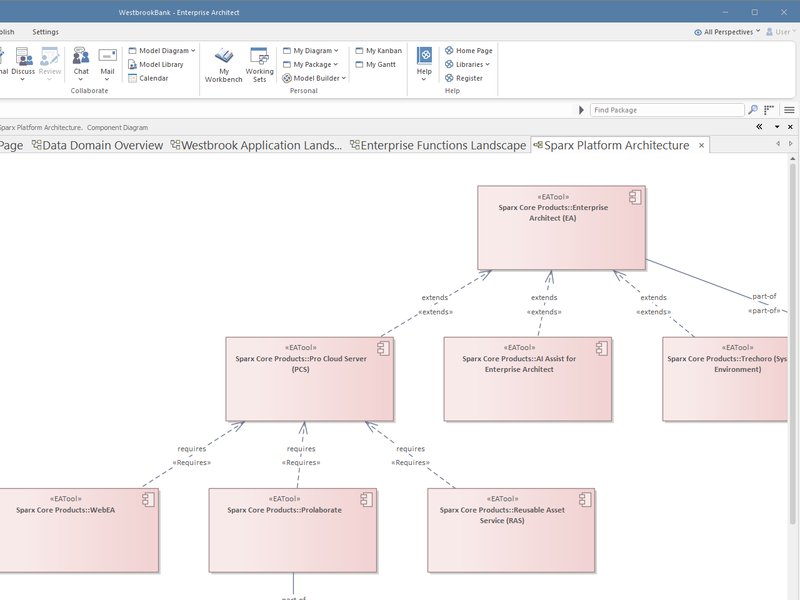
Today the architect reads the brief, searches the repository for what exists and builds the solution model element by element. AI-augmented, the architect gives AI the brief and the live repository, with the design intent and constraints stated up front. AI finds existing elements, creates new ones with the right stereotypes and lays out a first diagram.
The skill is stating the intent and constraints clearly, then reading the result critically and discarding what does not fit.
Reusing what already exists
Today reuse depends on the architect knowing, or remembering to search, what the repository already holds. AI-augmented, the architect asks which applications, services and interfaces already overlap with the brief before anything new is created.
The skill is deciding whether to reuse, extend or build, and being able to say why.
Seeing what a change touches
Today the architect works out the impact of a design from memory and a few conversations. AI-augmented, the architect asks the repository what a design change touches, where the dependencies run and what breaks downstream, across the whole enterprise.
The skill is knowing whether the dependencies the model shows are the complete set.
Checking conformance while you build
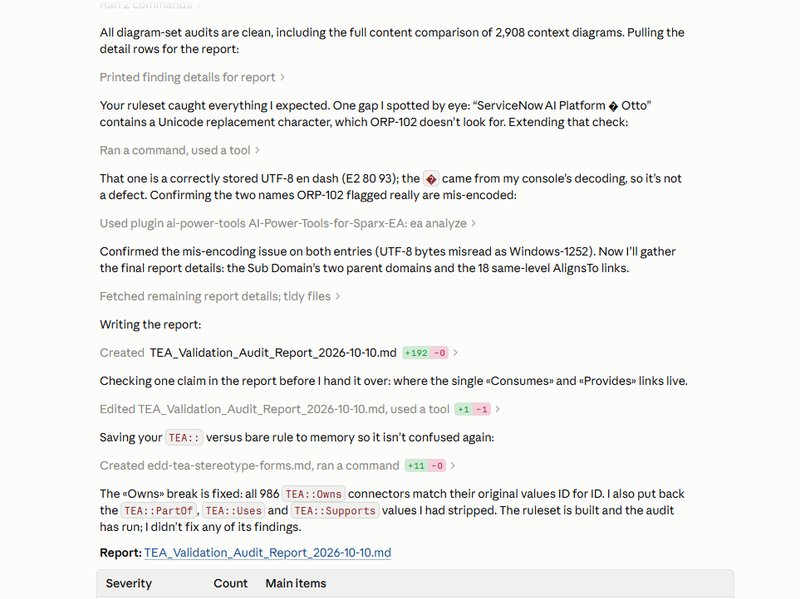
Today a wrong connector, a missing tagged value or a dependency on a deprecated component is found at the design review. AI-augmented, the architect states the MDG and governance rules, and AI validates the model while it is built, citing the rule and separating the mechanical fixes from the calls that need a reviewer.
The skill is writing rules the model can run, and deciding which findings a reviewer needs to see.
Choosing the right diagram for the audience
Today the architect picks a diagram type from habit and lays it out by hand for each review. AI-augmented, the architect states the question the reviewer needs answered, and AI proposes the diagram type that answers it and composes a readable layout.
The skill is knowing what the audience needs to see and what to leave out.
Briefing the sponsor
Today the briefing is a slide written from memory of what was built. AI-augmented, the architect states what the sponsor has to decide, and AI generates a plain-language briefing from the repository, with business aliases, ownership and criticality from tagged values, and dependencies summarized.
The skill is writing for the decision, and deciding what the briefing commits to.
Which tools help with this work, and when
The right tool depends on the job and on where the people who need the answers already work. For stakeholders it is usually the tool they already have open.
- Claude + AI Power Tools
The widest range of guided solution architecture work: building the model from the brief, reusing what exists, checking conformance as the model is built and briefing the sponsor, on the live repository.
- GitHub Copilot + AI Power Tools
The same work from VS Code, for architects who already work there.
- Kernaro Assist
Works inside Enterprise Architect as architects model, checking the design against your MDG and governance rules while it is built, with the rule cited.
- Kernaro AI Hub
Answers the reuse and “what does this change touch?” questions across the whole repository.
- Prolaborate 6 with AI
Gives sponsors and delivery teams plain-language briefings in a browser, with no EA modeling skills needed.
- Microsoft 365 Copilot
Read-only. Sponsors and delivery teams can ask what a design touches in Teams or Outlook, answered from a published Power BI model or, with Kernaro AI Hub, through its read-only API.
"To use AI agents effectively, you have to know how to do the job. The agents are tools for someone who already understands the discipline. They amplify expertise. They don't manufacture it."Ryan Schmierer, The Value Shift
The architect still owns the design
AI can confirm a solution model is complete and conformant: every required tagged value present, every connector typed, every rule satisfied. It cannot tell you whether the model is correct: whether this is the right design for the problem, whether the trade-offs serve the business, whether the dependency it can't see was simply never captured.
Closing that gap is the architect’s job. The architect translates between what the business needs and what the IT estate does, makes the design decision and owns the consequences. AI can take on tasks. The architect owns the solution.
How we help
Train and mentor your architects
Training and mentoring that teach your architects to go from the brief to a conformant model, check impact and brief sponsors, on your own repository, then stay with them until the new habits stick.
For ArchitectsBuild the model for you
Consulting for organizations that are capacity constrained or need results quickly. We build the solution models in your repository from your project briefs, and hand them over complete and current.
Build the model for you
Frequently asked questions
Does AI replace the architect in solution design?
No. AI scales the mechanical work: scaffolding the model from a brief, typing connectors to your standard, tracing dependencies, drafting briefings. The architect still decides whether the design is right for the problem, what trade-offs the business can accept, and what the model must say.
What does the repository need before this works?
A governed Sparx EA repository with an MDG that defines your stereotypes, connector conventions, and tagged values. Ungoverned standards produce fast, confident, non-conformant models. We assess whether your repository is ready as part of the engagement and remediate the foundation as needed.